Sugar glider care: diet, housing and whether it suits you
The sugar glider is a small, gliding, nocturnal and highly social marsupial that should not live alone, needs a diet that is hard to balance and requires a vet experienced with exotic animals. It can live for around a decade in captivity and needs attention every night, so it is not a suitable pet for beginners. If you are considering one, look at its real needs and the rules that apply to it first.
What is a sugar glider?
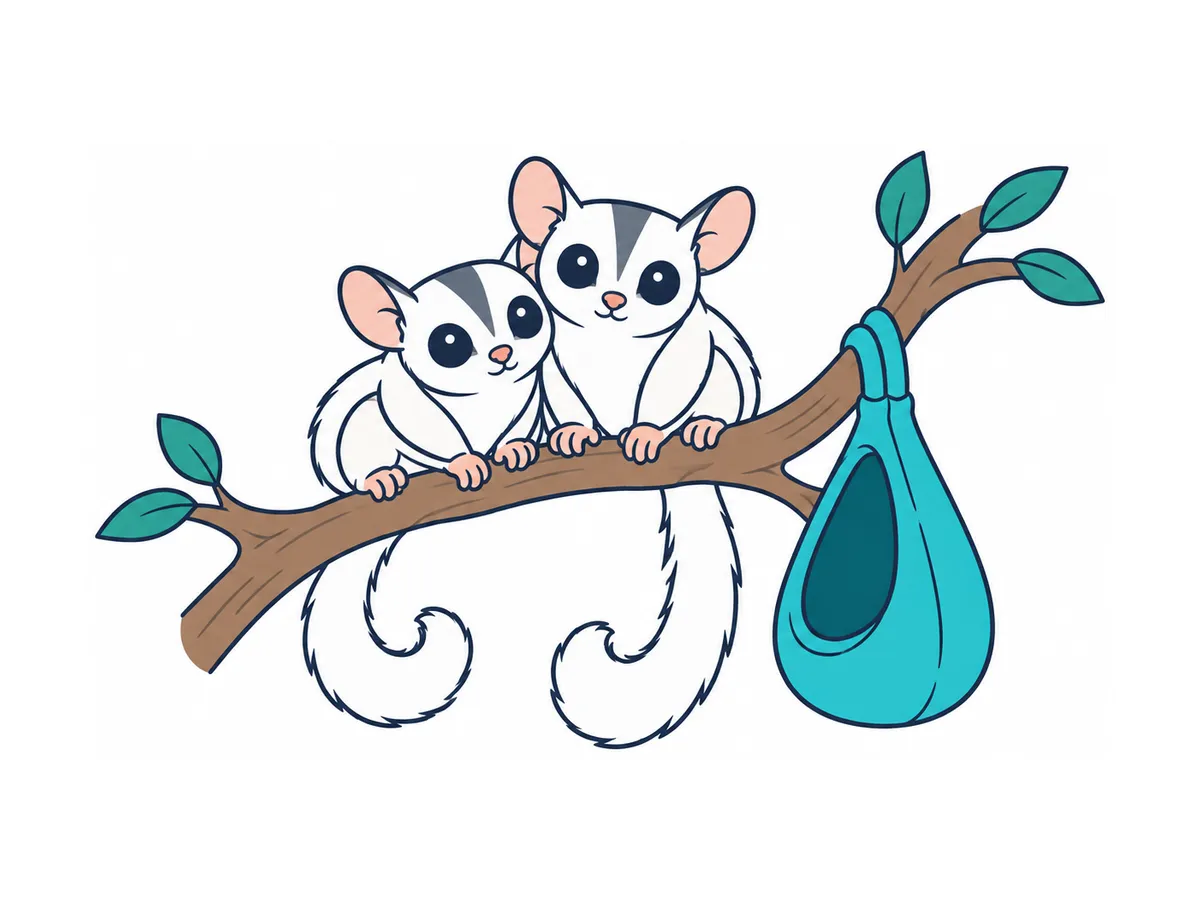
The sugar glider (in Spanish you will see it called petauro del azúcar, petauro de la miel or simply petauro) is a marsupial of the species Petaurus breviceps. As with kangaroos, the female carries and nurses her young in a pouch on her belly. It is not a rodent, although its size invites the comparison.
Its most striking feature is a membrane of skin, the patagium, which joins the front legs to the back legs and allows it to glide. An adult weighs roughly 85 to 170 grams, and males are usually a little larger than females.
It is a nocturnal animal: it sleeps during the day and is most active and noisy in the evening and at night. That timetable, which clashes with most households, is the first thing to think through carefully.
Is a sugar glider a good pet? Why it is not for beginners
Sugar gliders are appealing because of their size and looks, but their care is demanding and specialised. These are the main reasons:
- Night-time schedule. Waking or handling them during the day causes stress and can increase the risk of illness.
- They need company of their own species as well as daily time with you: the Merck Veterinary Manual refers to at least two hours of interaction every evening or night.
- Complex diet. Nutritional problems are common and cannot be solved with just any pellet.
- Long commitment. With good care they live about 9-12 years in captivity.
- Specialist vet. Not every clinic treats exotic animals, and it is best to find one before a problem arises.
Questions to answer before you decide
- Can you give them time every night for more than a decade?
- Do you have a quiet space where they can rest during the day?
- Are there other animals or young children at home who might unsettle them? Merck advises against interaction with other pets.
- Do you have an exotic animal vet nearby and a budget for check-ups and emergencies?
If any answer is “no”, it is probably not the right time to keep sugar gliders.
Why a sugar glider should not live alone
In the wild they live in colonies, and at home they are happiest in pairs or small groups. A glider kept alone, or with a companion it does not get on with, suffers social stress, which can show in several ways:
- Overgrooming and fur loss, often at the base of the tail.
- Self-injury.
- Changes in eating or drinking, or eating their own droppings.
- Repetitive movements, such as pacing back and forth in the cage.
Your company does not replace that of another glider. If you plan to house animals together, ask your vet how to introduce them and about breeding, so you avoid litters you cannot care for.
Sugar glider diet
Diet is the hardest part to get right. According to Merck, the basis is an artificial nectar (around half of the diet), complemented by a commercial pellet made for the species and calcium-treated insects. Fruit and vegetables should be an extra making up no more than 10% of the total.
Some practical guidelines:
- Split food into two meals a day and always leave fresh water available.
- Avoid chocolate, sweets, canned fruit, fruit pits and seeds, raw meat and eggs, caffeine and frequent fatty treats.
- Do not improvise supplements. Calcium with vitamin D3 or multivitamins should be the ones your vet recommends.
- Offer hard-bodied insects, which help limit tartar. Soft or high-sugar diets are linked to tooth decay, infections and dental abscesses.
A poorly balanced diet can lead to malnutrition and metabolic bone disease, so it is worth planning the menu with an exotic animal vet from day one.
Cage, temperature and daily routine
Because they climb and glide, height matters as much as floor space. Merck suggests at minimum a sturdy, lockable wire mesh cage about 61 cm long, 91 cm wide and 91 cm high, with gaps no larger than roughly 2.5 × 1.3 cm.
Inside, they need:
- A nest box or hanging pouch with space above it, so they do not damage the patagium.
- Safe branches, swings, toys and hiding places.
- Bedding of recycled paper or aspen shavings; never pine or cotton.
The ideal temperature is around 27-31 °C, away from air vents and direct sunlight. Keep them in a quiet area during the day. Time out of the cage is important, but always supervised: an unsupervised glider can easily get hurt.
Health: when to see the vet
A sugar glider needs a check-up when it arrives home and annual check-ups that include faecal tests. See your exotic animal vet if you notice:
- Weakness, poor appetite or weight loss.
- Abnormal droppings or bald patches.
- Difficulty breathing.
- Dragging of the back legs.
- Sunken eyes, a dry mouth or nose, or marked lethargy, which may point to dehydration.
Dehydration can be fatal: if your glider is very lethargic or dehydrated, take it to the vet immediately. The same applies if you suspect it has eaten something toxic. Wash your hands after handling it and ask your vet whether isolation is needed and how to minimise the stress of separation. This guide is for general information and does not replace a veterinary consultation.
Is it legal to keep a sugar glider in Spain?
Spain’s Law 7/2023 on the protection of animal rights and welfare (in Spanish) creates a positive list of companion animals (Article 35): a wild animal kept in captivity can only be considered a companion animal if its species is on the list. The law sets out a transitional regime for animals already kept before the list covering them is approved.
Before buying or taking in a sugar glider, check the current status of that list and your regional government’s rules, and always ask for documentation on the animal’s origin.
To bring an organised history to appointments, you can keep your pet’s care records and reminders in Miwuki Pet Life. Always follow your vet’s individual advice.
If you are considering another species, see our comparison of small mammals and their needs: small size does not mean easy care.
Conclusion
The sugar glider is a fascinating animal, but not an easy pet: it is nocturnal and needs others of its kind, a very specific diet, a tall cage and an exotic animal vet for around ten years. If you can take all that on and the law allows it, research thoroughly first; if not, admiring it from a distance is also a way of looking after it.