
Miwuki Report on Pet Adoption in Spain
Miwuki Report on Pet Adoption in Spain
What happens to the animals listed for adoption on Miwuki in Spain: cases, interest from families and recorded adoptions, with methods and limits.


Listed cases
104,876
Since February 2017

Recorded adoptions
64,447
Since March 2017

Adoption requests
58,285
Since June 2023

Recorded returns
580
What we see on Miwuki
Every day, shelters, associations and families list animals looking for a home on Miwuki. This report gathers what that activity tells us: how many animals are listed, how much interest they attract, how many adoptions are recorded and what has changed over the years.
It is a picture of what happens on Miwuki, not a statistic of every animal abandoned or adopted in Spain. Each figure states what it measures, which period it covers and what it does not allow us to conclude.
Scope: cases listed on Miwuki in Spain between 12 February 2017 and 22 October 2026, the data cut-off date. This page covers that whole period; each year has its own report.
The big picture
- 104,876cases listed since the launch
- 64,447adoptions recorded in Spain
- 19median days until a puppy is adopted
- 56median days if it is hard to place
- 65.8%of dogs got no requests within 90 days
- 27.1%of written reasons mention housing

Read the full analysis
What has happened
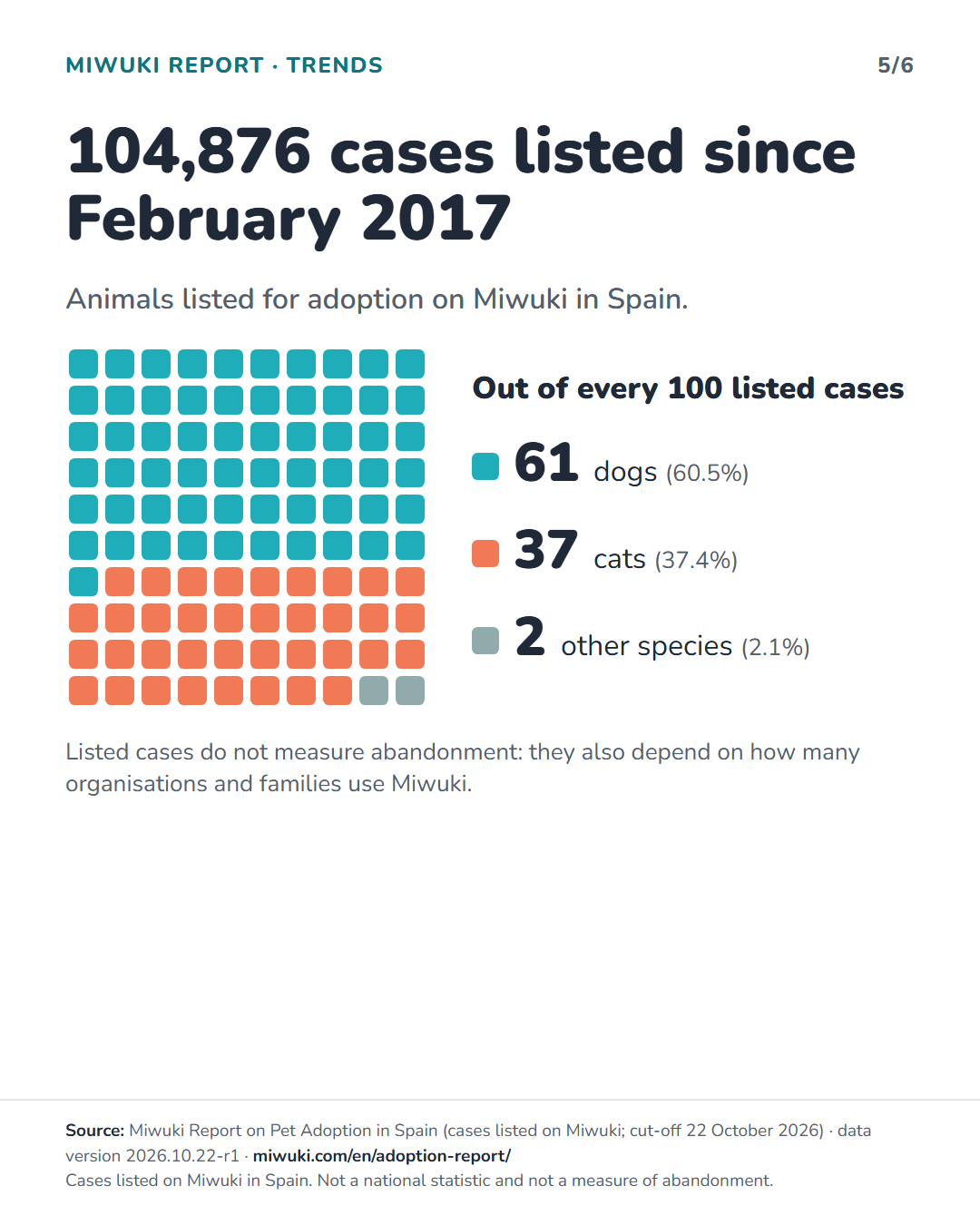
- Cases listed: 104,876 animal cases listed for adoption in Spain since February 2017. 60.5% were dogs and 37.4% were cats.
- Recorded adoptions: 64,447 adoptions recorded on the platform in Spain since March 2017, the month of the first one. Counting every country where Miwuki operates, there are 66,143.
- Adoption requests: 58,285 requests since June 2023, sent by 28,813 people.
The picture on the cut-off date
Of all the cases listed since February 2017, 62.8% appear as adopted on the cut-off date and 31.6% are still up for adoption. This is a snapshot of that day, not a count of the adoptions in a given year.
How has it changed?
Shelters and private owners since 2017
71,497cases listed by shelters and other organisations
- 33,379cases from private owners, since December 2018
- 31.8%of all cases, from private owners
- 104,876cases listed since the launch in 2017

Partial period: 2017, 2026
Notes, marked milestones and chart data
2026 is a partial year.
- February 2017 · Official public launch
- December 2018 · Private individuals arrive and a fuller profile
- June 2019 · The “Perfect pet” form begins
- March 2020 · COVID-19: state of alarm
- June 2023 · Platform update
Data as a table
| Period | Total | Dogs | Cats |
|---|---|---|---|
| 2017 | 6,604 (Partial period) | 4,103 (Partial period) | 2,462 (Partial period) |
| 2018 | 10,968 | 6,623 | 4,247 |
| 2019 | 14,709 | 9,366 | 5,124 |
| 2020 | 11,950 | 7,049 | 4,687 |
| 2021 | 12,026 | 6,790 | 5,022 |
| 2022 | 12,285 | 7,531 | 4,484 |
| 2023 | 11,090 | 7,422 | 3,487 |
| 2024 | 10,164 | 6,314 | 3,576 |
| 2025 | 8,902 | 4,981 | 3,559 |
| 2026 | 6,178 (Partial period) | 3,297 (Partial period) | 2,583 (Partial period) |
Source: Miwuki Report on Pet Adoption in Spain · cut-off 22 October 2026 What IND-01 measures
Partial period: 2017, 2026
Notes, marked milestones and chart data
2026 is a partial year. Private individuals have been listing animals since December 2018.
- February 2017 · Official public launch
- December 2018 · Private individuals arrive and a fuller profile
- June 2019 · The “Perfect pet” form begins
- March 2020 · COVID-19: state of alarm
- June 2023 · Platform update
Data as a table
| Period | Total | Shelters and other organisations | Private individuals |
|---|---|---|---|
| 2017 | 6,604 (Partial period) | 6,604 (Partial period) | 0 (0) |
| 2018 | 10,968 | 10,844 | 124 |
| 2019 | 14,709 | 10,428 | 4,281 |
| 2020 | 11,950 | 8,459 | 3,491 |
| 2021 | 12,026 | 8,286 | 3,740 |
| 2022 | 12,285 | 7,413 | 4,872 |
| 2023 | 11,090 | 6,525 | 4,565 |
| 2024 | 10,164 | 5,163 | 5,001 |
| 2025 | 8,902 | 4,624 | 4,278 |
| 2026 | 6,178 (Partial period) | 3,151 (Partial period) | 3,027 (Partial period) |
Source: Miwuki Report on Pet Adoption in Spain · cut-off 22 October 2026 What IND-01 measures
Partial period: 2017, 2026
Notes, marked milestones and chart data
2026 is a partial year. It only counts the adoptions recorded on Miwuki, and how much is recorded changes over the years.
- February 2017 · Official public launch
- December 2018 · Private individuals arrive and a fuller profile
- June 2019 · The “Perfect pet” form begins
- March 2020 · COVID-19: state of alarm
- June 2023 · Platform update
Data as a table
| Period | Total |
|---|---|
| 2017 | 2,353 (Partial period) |
| 2018 | 7,136 |
| 2019 | 9,025 |
| 2020 | 9,521 |
| 2021 | 7,838 |
| 2022 | 7,582 |
| 2023 | 6,650 |
| 2024 | 5,731 |
| 2025 | 5,076 |
| 2026 | 3,535 (Partial period) |
Source: Miwuki Report on Pet Adoption in Spain · cut-off 22 October 2026 What IND-05 measures
Read the full analysis
Since February 2017, shelters and other organisations have listed 71,497 cases and private individuals, who have been listing since December 2018, 33,379: 31.8% of the total. The charts show, for each year, how many cases were listed, of which species, who listed them and how many adoptions were recorded.
More or fewer cases being listed does not mean more or less abandonment. The number also depends on how many organisations and families use Miwuki and how they use it. Platform changes, such as the arrival of private individuals or the new platform of June 2023, are marked on the charts.
Part 1 of 5
The animals
Which animals are listed on Miwuki: their species, age and size, what their profile says, where they come from and where they are listed.
Who is looking for a home?
60.5%of all cases were dogs
- 37.4%were cats
- 41.7%were puppies or kittens
- 2.6%were seniors

Percentage of all dogs and all cats listed since February 2017. Age estimated by whoever listed the animal.
View the data as a table
| Category | Dogs | Cats |
|---|---|---|
| Puppy or kitten | 35.1% | 53.5% |
| Young | 34.8% | 25.7% |
| Adult | 23.0% | 15.4% |
| Senior | 3.5% | 1.3% |
Source: Miwuki Report on Pet Adoption in Spain · cut-off 22 October 2026 What IND-12 measures
Read the full analysis
Of all the cases listed since February 2017, 60.5% were dogs and 37.4% were cats.
By age, as stated by whoever listed them: 41.7% were puppies or kittens, 31.6% young, 20.2% adults and 2.6% seniors. Among cats, kittens reach 53.5%.
Since June 2023, when dog size started to be derived from the breed (or from the mixed-breed category by weight), 58.2% of listed dogs were medium-sized, 17.0% large and 14.9% small; 53.8% were mixed breed. Since the December 2018 profile, 1.6% of dogs had to be adopted together with another animal.

Health, temperament and identification
- 7.0%of dogs had the PPP flag
- 1.8%of dogs were flagged with leishmania
- 30.6%of cats from private individuals, microchipped
- 75.1%of shelter cats, microchipped
- 56.9%of dogs get on well with children
Read the full analysis
Of all the dogs listed since February 2017, 7.0% carried the potentially dangerous dog (PPP) flag and 1.8% were flagged with leishmaniasis. When listed, 30.6% of cats from private individuals had a microchip, compared with 75.1% of shelter cats. Since the December 2018 profile, according to publishers, 56.9% of dogs get on with children. These flags are set by the publisher.
Where do they come from?
When listing, shelters state where the animal comes from. Of all their cases since 2019, 59.9% were recorded as “taken in by the shelter”, 16.0% as “found in the street” and 8.3% as an unwanted litter. It is stated by the publisher and the list mixes origin and reason. Before 2019 almost all cases have the same origin, so the figures start that year.
Partial period: 2026
Notes, marked milestones and chart data
Percentage of cases listed by shelters and other organisations each year, by the origin they state when listing. Since 2019.
Data as a table
| Period | Taken in by the shelter | Found in the street | Unwanted litters (shelters) |
|---|---|---|---|
| 2019 | 56.4% | 14.1% | 7.4% |
| 2020 | 62.6% | 14.1% | 8.7% |
| 2021 | 62.4% | 11.7% | 9.1% |
| 2022 | 63.1% | 13.3% | 11.6% |
| 2023 | 54.7% | 16.5% | 13.3% |
| 2024 | 59.0% | 22.0% | 4.2% |
| 2025 | 60.4% | 24.3% | 3.1% |
| 2026 | 60.6% (Partial period) | 22.7% (Partial period) | 3.9% (Partial period) |
Source: Miwuki Report on Pet Adoption in Spain · cut-off 22 October 2026 What IND-14 measures
Where are animals listed?
This is how all the cases listed on Miwuki in Spain since February 2017 are spread across provinces. It shows where the platform is used, not where there is more abandonment or which provinces do better or worse: the volume depends on how many organisations and families in each province list animals on Miwuki.
We show all provinces, including those with few cases.
Activity on Miwuki, not the incidence of abandonment. All cases listed since February 2017.
Source: Miwuki Report on Pet Adoption in Spain · cut-off 22 October 2026 What IND-16 measures
Part 2 of 5
Why do they need a new home?
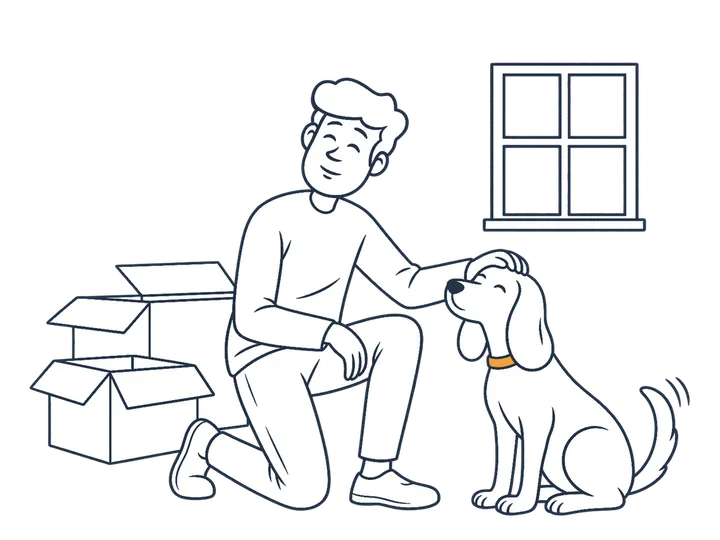
What private individuals explain when they list their animal on Miwuki, and how much housing weighs in those reasons.
What reasons do private individuals give?
Why private individuals look for a new home for their animal
- 20.9%chose “lack of time or space”
- 16.5%chose a change of address
- 21.3%of written reasons mention a move
- 14.5%mention a home that does not allow it
Partial period: 2018, 2026
Notes, marked milestones and chart data
Percentage of each year's cases from private individuals. Since the December 2018 profile.
Data as a table
| Period | Lack of time and/or space | Owner moving house or relocating | Allergies |
|---|---|---|---|
| 2018 | 27.4% (Partial period) | 13.7% (Partial period) | 4.0% (Partial period) |
| 2019 | 12.8% | 13.0% | 6.1% |
| 2020 | 17.2% | 15.0% | 6.8% |
| 2021 | 19.2% | 14.8% | 6.8% |
| 2022 | 20.4% | 14.9% | 6.8% |
| 2023 | 25.0% | 17.7% | 7.8% |
| 2024 | 24.8% | 19.1% | 8.4% |
| 2025 | 24.4% | 18.7% | 8.4% |
| 2026 | 22.2% (Partial period) | 18.6% (Partial period) | 6.5% (Partial period) |
Source: Miwuki Report on Pet Adoption in Spain · cut-off 22 October 2026 What IND-38 measures
Read the full analysis
Since December 2018, private individuals choose a reason from a list when listing, and since June 2023 they also explain it in their own words. From the list, since December 2018, 20.9% chose “lack of time or space” and 16.5% a change of address; 10.9% listed a litter. In their own words, since June 2023, 24.4% of written reasons mention a lack of time or work, 21.3% a move and 14.5% a home where pets are not allowed. Texts are classified automatically and are never published.
Housing and pets
What private individuals say about their home
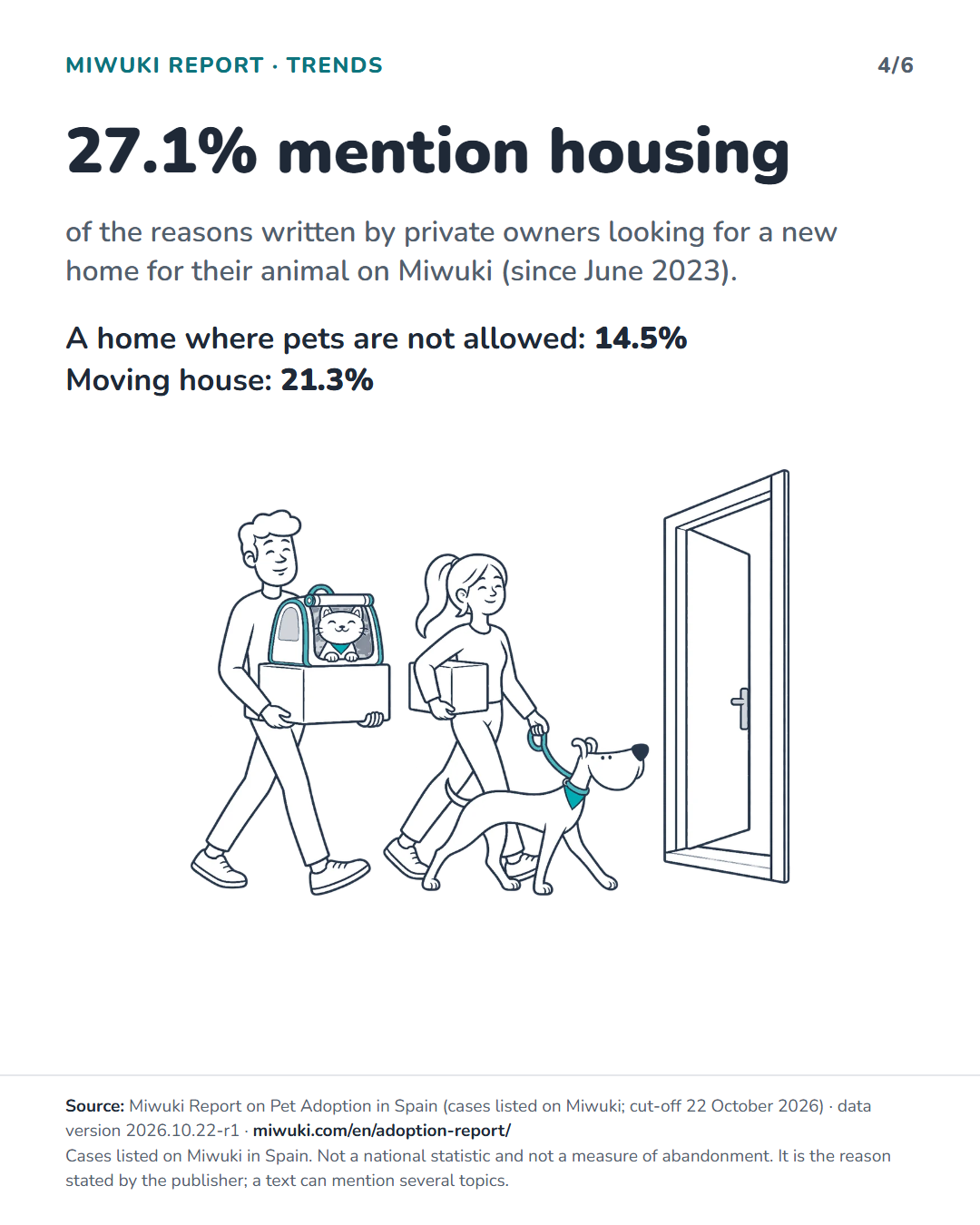
27.1%of written reasons mention housing
- 14.5%mention a home where pets are not allowed
- 21.3%mention moving house
- 4.3%chose “pets not allowed” from the list
Partial period: 2018, 2026
Notes, marked milestones and chart data
Percentage of cases from private individuals each year. The platform changed in June 2023.
Data as a table
| Period | Pets not allowed at home | Owner moving house or relocating |
|---|---|---|
| 2018 | 2.4% (Partial period) | 13.7% (Partial period) |
| 2019 | 2.8% | 13.0% |
| 2020 | 3.4% | 15.0% |
| 2021 | 3.0% | 14.8% |
| 2022 | 3.5% | 14.9% |
| 2023 | 5.0% | 17.7% |
| 2024 | 5.6% | 19.1% |
| 2025 | 5.2% | 18.7% |
| 2026 | 6.6% (Partial period) | 18.6% (Partial period) |
Source: Miwuki Report on Pet Adoption in Spain · cut-off 22 October 2026 What IND-38 measures
Read the full analysis
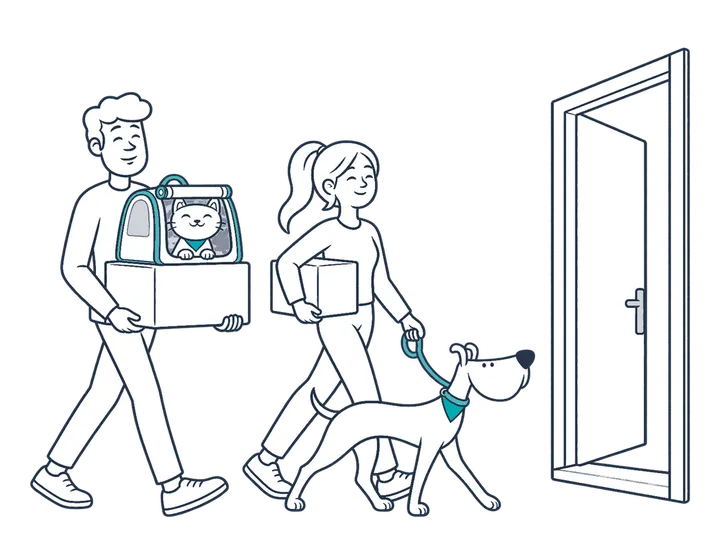
When a private individual looks for a new home for their animal on Miwuki, they explain the reason in two ways: they choose an option from a list and, since June 2023, they also explain it in their own words. Of all the reasons written since then, 27.1% mention housing: 14.5% a home where pets are not allowed and 21.3% moving house. Among dogs, 28.9%; among cats, 22.0%.
From the list, since December 2018, 4.3% chose “pets not allowed at home” and 16.5% a change of address. The figures differ because only one option can be chosen from the list (a home that does not allow pets may end up as “change of address” or “lack of time or space”), whereas a single text can mention several topics.
Over the years, “pets not allowed at home” rose from 2.8% of cases from private individuals in 2019 to 5.2% in 2025, and change of address from 13.0% to 18.7%, as the chart shows. The platform changed in June 2023, so the comparison between years is only indicative.
It is the reason stated by the publisher: we do not know how many people give up adopting because of housing or how many animals are abandoned because of it, and it only describes the private individuals who list on Miwuki. The “Housing and pets” page brings all the data together.
Part 3 of 5
Who wants to adopt
Who sends adoption requests through Miwuki, how they live and what people who fill in the “Perfect pet” form are looking for.
How much interest do they attract?
Families' interest since June 2023
58,285adoption requests since June 2023
- 28,813people sent requests
- 34.0%of requests for dogs came from another province
- 60.1%of people who sent requests were women

Partial period: Jun 2023, Oct 2026
Notes, marked milestones and chart data
Daily average for each month, to compare months of different length.
Data as a table
| Period | Total |
|---|---|
| Jun 2023 | 36.4 (Partial period) |
| Jul 2023 | 41.7 |
| Aug 2023 | 54.0 |
| Sept 2023 | 52.1 |
| Oct 2023 | 49.3 |
| Nov 2023 | 59.9 |
| Dec 2023 | 52.6 |
| Jan 2024 | 57.3 |
| Feb 2024 | 50.4 |
| Mar 2024 | 53.4 |
| Apr 2024 | 53.1 |
| May 2024 | 56.1 |
| Jun 2024 | 48.4 |
| Jul 2024 | 49.5 |
| Aug 2024 | 52.9 |
| Sept 2024 | 53.4 |
| Oct 2024 | 48.6 |
| Nov 2024 | 56.2 |
| Dec 2024 | 47.1 |
| Jan 2025 | 53.7 |
| Feb 2025 | 48.9 |
| Mar 2025 | 37.2 |
| Apr 2025 | 35.7 |
| May 2025 | 39.5 |
| Jun 2025 | 29.1 |
| Jul 2025 | 30.9 |
| Aug 2025 | 44.5 |
| Sept 2025 | 36.0 |
| Oct 2025 | 40.7 |
| Nov 2025 | 38.1 |
| Dec 2025 | 38.0 |
| Jan 2026 | 47.8 |
| Feb 2026 | 42.7 |
| Mar 2026 | 35.9 |
| Apr 2026 | 34.6 |
| May 2026 | 37.0 |
| Jun 2026 | 38.8 |
| Jul 2026 | 49.6 |
| Aug 2026 | 67.6 |
| Sept 2026 | 72.7 |
| Oct 2026 | 80.2 (Partial period) |
Source: Miwuki Report on Pet Adoption in Spain · cut-off 22 October 2026 What IND-08 measures
Distinct people since June 2023, by the age in their profile at their last request.
Source: Miwuki Report on Pet Adoption in Spain · cut-off 22 October 2026 What IND-27 measures
Read the full analysis
Since June 2023, 28,813 people have sent 58,285 adoption requests to animals listed on Miwuki in Spain.
A request is not an adoption: it shows interest in a specific animal, and the same person may ask for several animals. These data are available from June 2023.
According to their profile, 60.1% of the people who have sent requests are women and 34.8% men; 26.6% were aged sixteen to twenty-four and 25.9% twenty-five to thirty-four. 34.0% of requests for dogs came from people in another province.
How do people who want to adopt live and what are they looking for?
How people who want to adopt a dog live
41.7%already have another dog, a cat or another pet
- 41.2%live in a large home with a balcony, patio or terrace
- 25.6%have young children at home
- 19.7%are about to have their first dog

“Perfect pet” form: percentage of all forms to adopt a dog since June 2019.
Source: Miwuki Report on Pet Adoption in Spain · cut-off 22 October 2026 What IND-33 measures
“Perfect pet” form: percentage of forms for each type of home that tick “large”. Several sizes can be ticked.
Source: Miwuki Report on Pet Adoption in Spain · cut-off 22 October 2026 What IND-33 measures
“Perfect pet” form: percentage of forms to adopt a dog. “Other animals” allows several answers.
Source: Miwuki Report on Pet Adoption in Spain · cut-off 22 October 2026 What IND-33 measures
“Perfect pet” form: percentage of the forms in each group.
Source: Miwuki Report on Pet Adoption in Spain · cut-off 22 October 2026 What IND-33 measures
Read the full analysis
The “Perfect pet” form asks people who want to adopt how they live and what animal they are looking for. Since June 2019, among those who filled it in to adopt a dog, 41.2% lived in a large home with a balcony, patio or terrace and 13.5% in a small one without any of them. 41.7% already had another dog, a cat or another pet at home: 22.5% already had a dog and 16.2% a cat. 25.6% had young children at home and for 19.7% it would be their first dog.
Housing is on the move too: 9.7% had moved house in the last two years and 7.3% were about to. 60.7% said the dog would be alone for under four hours a day and 56.8% that they would spend “whatever is needed” each month.
As for size, 69.1% ticked that they were looking for a small dog and 25.3% a large one (several can be ticked); among dogs listed since June 2023, 14.9% were small. The home does change the size people look for: 34.2% of those living in a large home with a balcony, patio or terrace ticked “large”, compared with 13.9% of those living in a small one without them. Having young children, by contrast, barely changes it: 22.5% of those with young children ticked “large”, compared with 26.2% of those without. People about to have their first dog, however, expect to leave it alone for longer: 50.6% said it would be alone for under four hours a day, compared with 63.2% of those who had had a dog before.
Only people who fill in the form answer it, so it does not represent everyone who adopts.
Part 4 of 5
Outcomes
How many animals find a family, how long it takes and which ones find it hardest. We only count the adoptions recorded on Miwuki.
How long does it take to find a home?
How long it takes and how many get no requests
- 49median days until an adult dog is adopted
- 43median days if it carries the PPP flag
- 84.4%of senior dogs got no requests within 90 days
- 76.5%of pairs to be adopted together got no requests
Median days among dogs adopted within 180 days.
Source: Miwuki Report on Pet Adoption in Spain · cut-off 22 October 2026 What IND-34 measures
Organisations also receive interest through other channels.
Source: Miwuki Report on Pet Adoption in Spain · cut-off 22 October 2026 What IND-35 measures
Read the full analysis
An adoption platform sees a part of the journey that other studies do not: how long each animal takes to find a family and how many attract no interest. These figures bring together every year with data: for adoptions, the cases listed by shelters from 2017 to 2025; for requests, the cases listed from June 2023 to 2025. Only complete years are included, so that every case has had the same time.
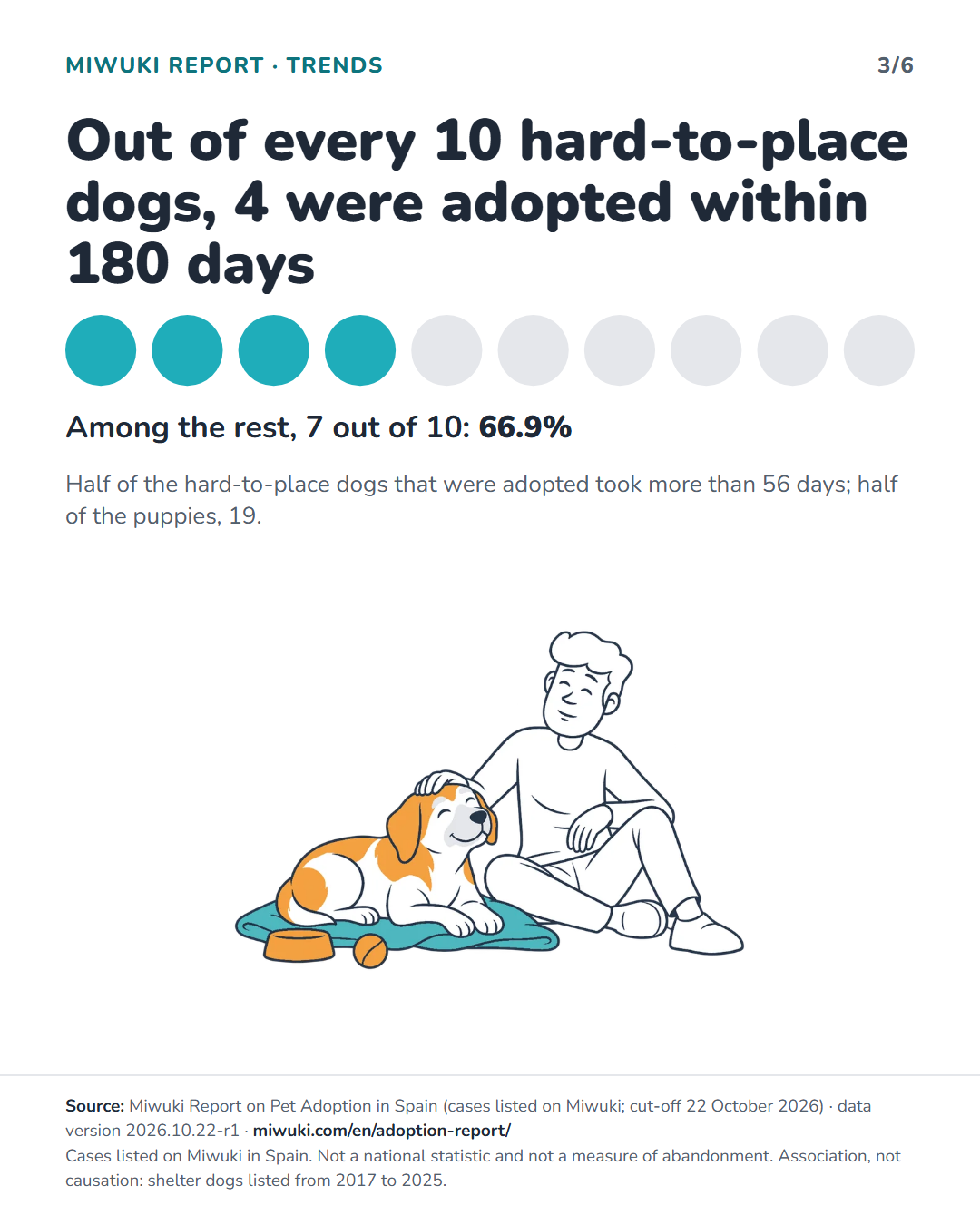
- The wait. Among shelter dogs adopted within 180 days, half of the puppies found a family in under 19 days; adults, in under 49; PPP dogs, in under 43; and hard-to-place dogs, in under 56.
- The invisible ones. 65.8% of dogs and 66.6% of cats received no request through Miwuki in their first 90 days. Among senior dogs, 84.4%; among hard-to-place dogs, 80.2%; and among those to be adopted together with another animal, 76.5%.
- The first month. 30.6% of dogs and 27.4% of cats received at least one request in their first month.
These are platform data: the requests and adoptions recorded on Miwuki. They describe what happens, not its causes, and organisations also receive interest through other channels.
Which animals find it hardest?
Who finds a home sooner?
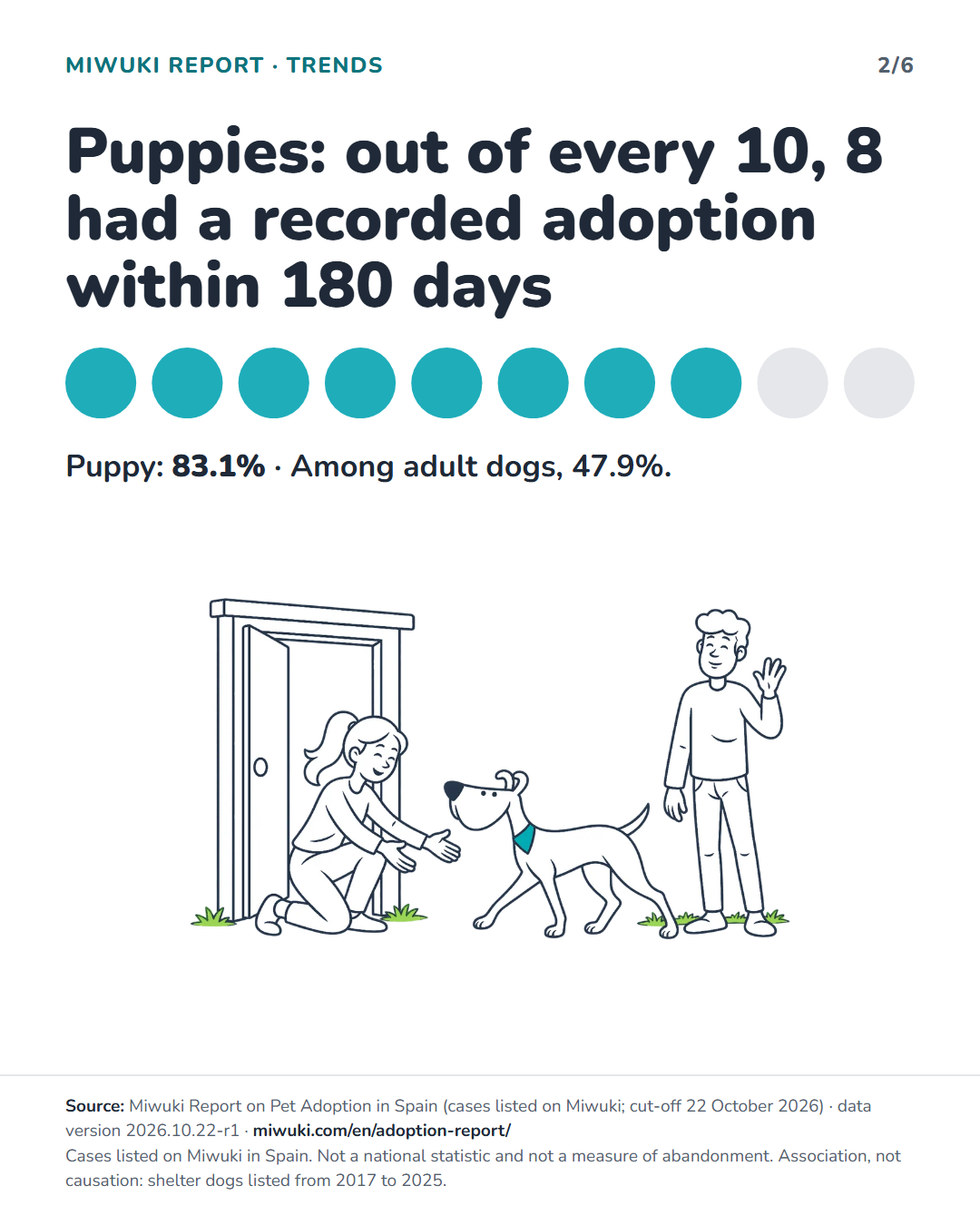
83.1%of puppies adopted within 180 days
- 47.9%of adult dogs
- 45.3%of senior dogs
- 37.1%of hard-to-place dogs

Cases listed by shelters from 2017 to 2025 with an adoption recorded within the following 180 days.
Source: Miwuki Report on Pet Adoption in Spain · cut-off 22 October 2026 What IND-21 measures
Read the full analysis
Of all the cases listed by shelters since February 2017, 7.9% carried the “hard to place” flag, which the publisher sets when an animal is likely to find it harder, for example because of its age or health. On Miwuki only shelters use it.
Among the dogs listed by shelters from 2017 to 2025, 83.1% of puppies had an adoption recorded within 180 days of listing, compared with 47.9% of adults (35.2 percentage points lower) and 45.3% of seniors. Among cats, 71.8% of kittens compared with 40.0% of adults.
With the “hard to place” flag, 37.1% of dogs were adopted within 180 days, compared with 66.9% of the others (29.8 percentage points lower). Of those listed from June 2023 to 2025, 10.0% of flagged dogs received at least one request in their first month, compared with 31.2% of the rest.
With the PPP flag, 45.4% of dogs were adopted within 180 days, compared with 65.9% of the rest; with leishmaniasis, 27.9%.
These are associations, not causes: the profile alone does not explain the difference, and we only count the adoptions that shelters record on Miwuki. Private individuals record few of their adoptions, so only shelters appear here.
H-GLOBAL-04Descriptive
Hard-to-place animals
7.9%
of shelter cases carried the “hard to place” flag
Details
Of all the cases listed by shelters since February 2017, 7.9% carried the “hard to place” flag: 7.5% of dogs and 8.2% of cats.
Limitation: The flag is optional and each publisher may use it differently. On Miwuki only shelters use it.
LinkCite
Miwuki. Miwuki Report on Pet Adoption in Spain. Trends since February 2017 (data version 2026.10.22-r1; data cut-off 22 October 2026). (finding H-GLOBAL-04). https://miwuki.com/en/adoption-report/#h-global-04
H-GLOBAL-05Association, not causation
Age and adoption
47.9%
of adult dogs were adopted within 180 days (puppies: 83.1%)
Details
Of the dogs listed by shelters from 2017 to 2025, 83.1% of puppies had an adoption recorded within 180 days of listing, compared with 47.9% of adults (35.2 percentage points lower) and 45.3% of seniors.
Limitation: Descriptive association in shelter cases: it does not show that age is the cause. It only counts adoptions recorded on Miwuki.
LinkCite
Miwuki. Miwuki Report on Pet Adoption in Spain. Trends since February 2017 (data version 2026.10.22-r1; data cut-off 22 October 2026). (finding H-GLOBAL-05). https://miwuki.com/en/adoption-report/#h-global-05
H-GLOBAL-06Association, not causation
Hard to place
37.1%
of hard-to-place dogs were adopted within 180 days
Details
With the “hard to place” flag, 37.1% of the dogs listed by shelters from 2017 to 2025 were adopted within 180 days, compared with 66.9% of the others (29.8 percentage points lower). Among cats, 38.6%, compared with 62.4%.
Limitation: Each shelter sets the flag voluntarily. It is an association, not a cause, and it only counts adoptions recorded on Miwuki.
LinkCite
Miwuki. Miwuki Report on Pet Adoption in Spain. Trends since February 2017 (data version 2026.10.22-r1; data cut-off 22 October 2026). (finding H-GLOBAL-06). https://miwuki.com/en/adoption-report/#h-global-06
H-GLOBAL-07Association, not causation
Days to adoption
49
median days until an adult dog is adopted
Details
Among shelter dogs listed from 2017 to 2025 and adopted within 180 days, half of the puppies found a family in under 19 days, half of the adults in under 49 (30 days more) and half of the hard-to-place dogs in under 56.
Limitation: It only counts shelter dogs adopted within 180 days, and the flag is set by the publisher. It is an association, not a cause.
LinkCite
Miwuki. Miwuki Report on Pet Adoption in Spain. Trends since February 2017 (data version 2026.10.22-r1; data cut-off 22 October 2026). (finding H-GLOBAL-07). https://miwuki.com/en/adoption-report/#h-global-07
H-GLOBAL-08Descriptive
No requests in the first quarter
84.4%
of senior dogs got no requests in their first 90 days
Details
Of the dogs listed on Miwuki from June 2023 to 2025, 65.8% received no request through the platform in their first 90 days; among seniors, 84.4%, and among hard-to-place dogs, 80.2%. Of cats, 66.6%.
Limitation: Organisations also receive interest through other channels: it does not mean that nobody was interested.
LinkCite
Miwuki. Miwuki Report on Pet Adoption in Spain. Trends since February 2017 (data version 2026.10.22-r1; data cut-off 22 October 2026). (finding H-GLOBAL-08). https://miwuki.com/en/adoption-report/#h-global-08



Throughout the year
Litters listed by private individuals concentrate in spring and summer: from 2019 to 2025, 17.3% of cat litters were listed in May, compared with 2.1% in January. Adding up every Christmas since 2017 (from 15 December to 6 January), cases were listed at a rate 10.9% fewer per day than in the previous three weeks, and adoptions were recorded at a rate 2.7% fewer per day than in the previous three weeks and 16.6% fewer per day than in the following three weeks.
Percentage of cat litters listed in each month; complete years from 2019 to 2025, pooled.
Source: Miwuki Report on Pet Adoption in Spain · cut-off 22 October 2026 What IND-30 measures
What can you do?
Look beyond puppies and kittens
84.4%of senior dogs got no requests within 90 days
- 65.8%of all dogs got no requests within 90 days
- 7.9%of shelter cases were flagged “hard to place”

Read the full analysis
If you are thinking of adopting
- Think about your everyday life: time, space, budget and plans. Adopting is a commitment for the animal's whole life.
- Talk to whoever listed the animal: tell them how you live and ask about its character, its health and what it needs.
- Look beyond puppies and kittens. Adults and seniors are also looking for a family, and their character is already known.
- If you cannot adopt right now, fostering or sharing their profiles also helps.
If you list animals
- Complete the profile with clear photos, age, size, temperament and how the animal gets on with others. It is good practice, although this report does not measure its effect.
- Record adoptions and returns on Miwuki. That way this report better reflects what happens.
If you are a journalist or researcher
- Always cite the period, the metric and the cut-off date. You will find the citation format, the methodology and the PDF reports on this website.
Explore the report
- Private owners. Which animals families put up for adoption and why, separately from shelters.
- Shelters. Which animals shelters and other organisations list, where they come from and how many find a home.
- Housing and pets. What private individuals say about their home: homes that do not allow pets and moving house.
- Reports by year. The 2026 edition, with 2025 data and a data cut-off of 22 October 2026, and the reports for 2017 to 2024, produced in 2026 with the same cut-off. Each one explains which data existed that year and what changed on the platform, such as the arrival of private individuals in December 2018 or the new platform of June 2023.
Part 5 of 5
About these data
What these figures measure, how they are calculated, what they do not allow us to conclude and what has changed on the platform over the years.
How do we measure it?
We use the platform's records, aggregated and without personal data. We publish all figures; percentages based on fewer than thirty cases carry a “small base” warning because they are unreliable. Every indicator has a public definition, and every version of the data is kept so that it can be cited.
The report counts cases from Miwuki's public launch on 12 February 2017. The platform's general figures (105,187 cases in Spain with the same cut-off) also include those from the earlier testing period, from November 2016, and the Miwuki website gives the adoptions of every country (66,143), not only those in Spain.
On this page, each figure covers the whole period in which the data exist, from the launch or from when the platform started recording them, and says so. Adoption and request rates bring together the cases of complete years. The year-by-year trend is in the charts and in each year's report.
Report downloads
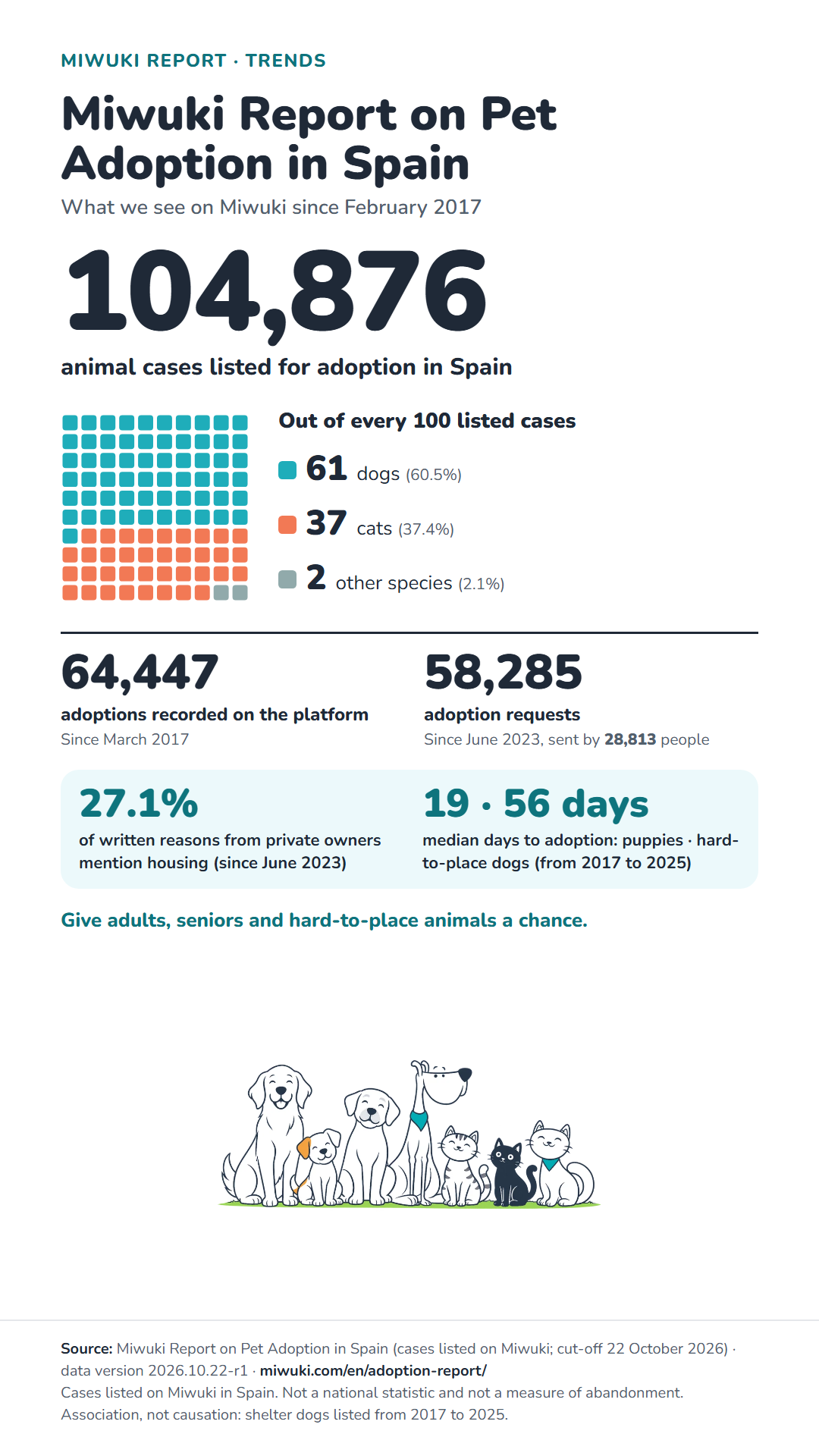
- PNGInfographic for sharing293 KB
- PDFVertical infographic397 KB
- PDFPrintable A4 infographic403 KB
- PDFLinkedIn document1.9 MB
Social media carousel (6 slides, PNG 1080 × 1350)
Read the infographic as text
What we see on Miwuki since February 2017
- 104,876 animal cases listed for adoption in Spain. 60.5% were dogs and 37.4% cats.
- 64,447 adoptions recorded on the platform. Since March 2017.
- 58,285 adoption requests. Since June 2023, sent by 28,813 people.
- 83.1% of puppies listed by shelters from 2017 to 2025 were adopted within 180 days. Compared with 47.9% of adult dogs (association, not causation).
Give adults, seniors and hard-to-place animals a chance.
Cases listed on Miwuki in Spain. Not a national statistic and not a measure of abandonment.
Source: Miwuki Report on Pet Adoption in Spain (cases listed on Miwuki; cut-off 22 October 2026).
Data version 2026.10.22-r1 · Data cut-off 22 October 2026
https://miwuki.com/en/adoption-report/
How to cite
Miwuki. Miwuki Report on Pet Adoption in Spain. Trends since February 2017 (data version 2026.10.22-r1; data cut-off 22 October 2026). https://miwuki.com/en/adoption-report/
Short credit: Source: Miwuki Report on Pet Adoption in Spain (cases listed on Miwuki; cut-off 22 October 2026).
The published figures, reports and infographics are licensed under CC BY 4.0 (Creative Commons Attribution): you may reuse them for any purpose, including commercial use, crediting the source, the data version and the cut-off date. The Miwuki logo and the illustrations are not covered by the licence.

What has changed on the platform?
Some figures change because the way data is recorded changes, not because what happens changes. We mark those moments on the charts so that nothing is compared that cannot be compared.
-
1 November 2016
Test phase
From November 2016, a few shelters tested the platform before it opened to the public. Cases from this phase are not included in the series.
-
2 February 2017
Official public launch
In February 2017 Miwuki officially opened to the public and thousands of people signed up within a few days. Case series start on launch day, 12 February, so 2017 is not a complete year and is not compared with 2018. Adoptions have been recorded since March 2017.
-
3 December 2018
Private individuals arrive and a fuller profile
Since December 2018, families who cannot keep their animal have also been listing cases. Before that only shelters and other organisations listed animals, so totals before and after do not have the same make-up. Since that same month, the profile also records the animal's temperament and compatibility, vaccination, deworming, allergies, whether it must be adopted together with another animal and, for private individuals, the reason chosen from a list.
-
4 June 2019
The “Perfect pet” form begins
In June 2019 the form in which people who want to adopt describe what they are looking for begins: size, whether it is their first animal, how many hours it would be alone and other circumstances at home.
-
5 March 2020
COVID-19: state of alarm
The state of alarm began on 14 March 2020. The way data are recorded did not change, but the context did: the reports compare those months with the previous year without attributing differences to the pandemic alone.
-
6 June 2023
Platform update
In June 2023 the way several data items are recorded changes. Earlier requests were loaded without their original date, so the request series starts on 14 June 2023. Dog size is now derived from the breed, which is mandatory; returns start being recorded regularly; the profile adds the health record book; and private individuals explain in writing why they are looking for a new home for their animal.
What these data do not allow us to conclude
- How many animals are abandoned in Spain. Listing a case on Miwuki is not the same as an abandonment, and many organisations and families do not use the platform.
- Why the figures change. Fewer cases or fewer requests may be due to many factors, such as how many organisations use Miwuki or changes to the platform itself. We describe what happens, not its causes.
- What share of requests ends in an adoption. Requests and adoptions are counted separately and do not form a funnel.
- Why some profiles are adopted sooner than others. We show differences by age, size or the hard-to-place flag, but not their causes: photos, description, the organisation or the area also play a part.
- Whether COVID-19 increased adoptions. This is a hypothesis we are studying with controls; for now it is not a conclusion.
- Who adopts. Most recorded adoptions do not include data about the adopter.
- Whether private owners' animals find a home sooner or later than shelter animals. Most private owners do not record their animal's adoption on Miwuki, so their figure is a minimum.
- Where there is more abandonment. The breakdown by province reflects where Miwuki is used, not the incidence of abandonment, and the origin stated by shelters describes their cases, not the whole of Spain.
- The size of dogs compared with years before June 2023, because the way it is recorded changed.