How much should a Boxer eat? Portions, meals and food
An adult Boxer should eat whatever amount keeps them at their ideal weight and in good body condition, and that figure depends on their weight, age, activity level, whether they are neutered and the food you use. Start with the manufacturer’s feeding guide, split the daily portion into at least two meals and adjust it as their shape changes. As a guide, WSAVA puts the needs of a healthy 30 kg adult dog at roughly 1,080 to 1,346 kcal a day.
What determines how much a Boxer eats
There is no single amount for the breed. These factors change the portion:
- Ideal weight: base your calculations on the weight they should be, not their current weight if they are over or under.
- Age: a growing puppy, an adult and a senior dog have different needs.
- Activity: a Boxer who runs every day does not eat the same as one who takes gentle walks.
- Neutering: it can change their energy needs.
- The food: gram for gram, two foods can provide very different amounts of calories.
- Treats and extras: they count too.
The WSAVA nutrition guidelines (World Small Animal Veterinary Association) put it this way: the energy each dog needs depends on their body condition, sex and neuter status, life stage, activity and environment, and it can vary by up to 30% either way between dogs. That is why the chart on the bag or a formula is only a starting point.
How much food an adult Boxer needs: a calorie guide
Indicative calories according to WSAVA
WSAVA publishes a calorie chart for healthy adult dogs in ideal body condition, calculated using the 2006 maintenance equations of the US National Research Council (NRC). These are some of its daily ranges:
- 22 kg: 850 to 1,067 kcal.
- 25 kg: 940 to 1,174 kcal.
- 28 kg: 1,020 to 1,278 kcal.
- 30 kg: 1,080 to 1,346 kcal.
- 32 kg: 1,130 to 1,413 kcal.
- 35 kg: 1,210 to 1,511 kcal.
WSAVA itself stresses that these figures are for guidance only: every dog is an individual and some need more or less to stay at their weight. Notice, too, that energy does not rise in proportion to weight: according to the same chart, a 15 kg dog needs 640 to 800 kcal, and a 30 kg dog needs less than double that.
From calories to grams of food
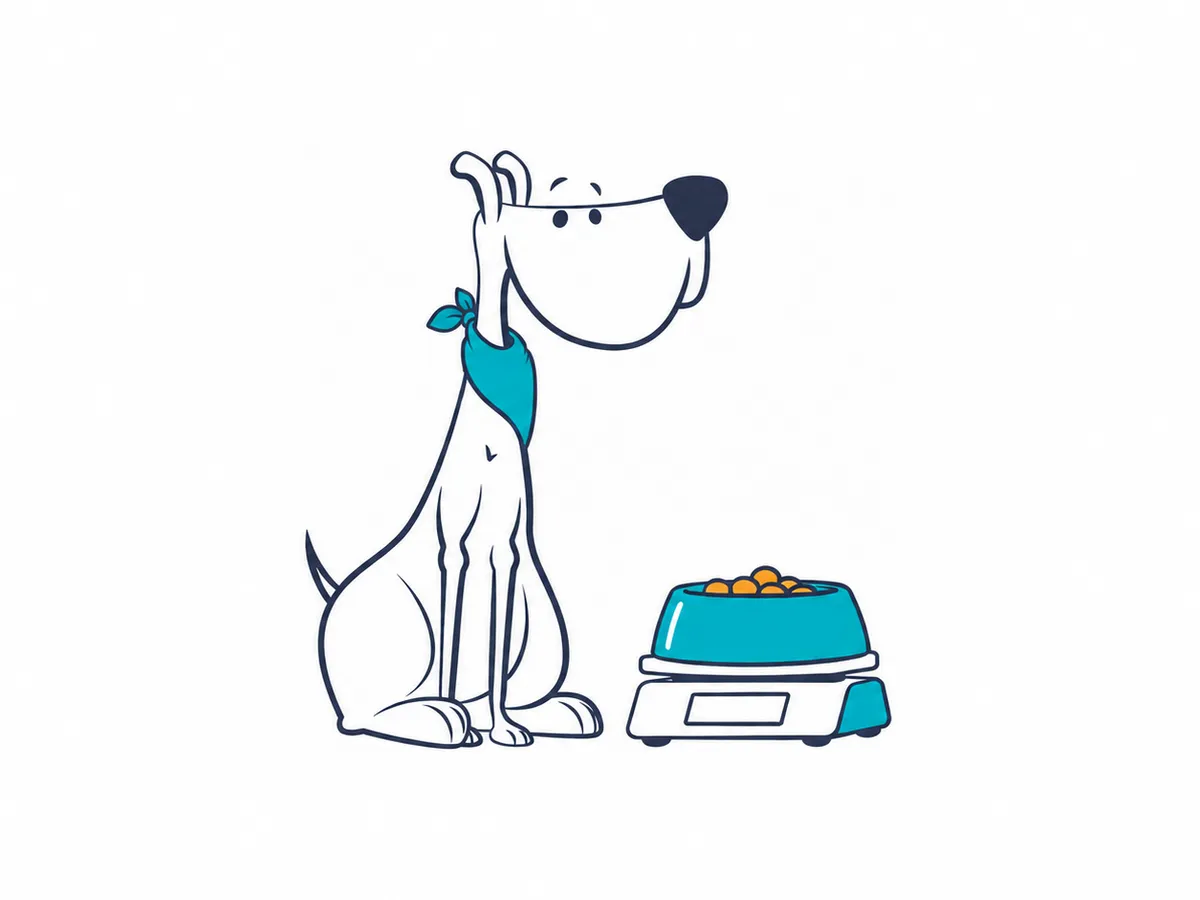
To convert calories into grams you need your food’s energy content, usually shown on the label or the manufacturer’s website as kcal per kilo or per 100 g. The sum is simple: grams per day = daily kcal ÷ kcal per gram.
For example, with a hypothetical food providing 3,600 kcal/kg (3.6 kcal per gram), 1,200 kcal works out at about 333 g a day. This is just a sample calculation: always use your own food’s figures, weigh the portion on kitchen scales and subtract whatever treats provide.
Boxer dog food: how to choose
What matters is not whether the bag says “Boxer”, but that it is a complete food for dogs at their life stage and that it agrees with them. A few pointers:
- Right for their age. Growth food for puppies and adult food afterwards; for older dogs, ask your vet whether a change makes sense.
- Clearly labelled. Look for the energy content, the ingredients and the feeding guide.
- Gradual changes. Mix the new food with the old one over several days to avoid stomach upsets.
- Vet-guided if there is illness. Allergies, digestive problems or weight-loss diets need an individual plan.
If your Boxer is a puppy, our guide to feeding a puppy will help with meals and switching foods. And if you are looking for food for an adult Boxer, the Miwuki Pet Food page has a recommender that offers guidance based on life stage, weight, activity and ingredients your dog should avoid; it is indicative and does not replace your vet.
How many times a day should a Boxer eat? (And bloat)
The Boxer is a deep-chested dog, and that matters when planning meals. The Merck Veterinary Manual explains that gastric dilatation-volvulus (bloat) mainly affects large, deep-chested dogs, and lists once-daily feeding, eating quickly, stress and age among its risk factors. To reduce the risk:
- Split the daily portion into at least two meals; if your vet recommends it, into more small ones.
- If they wolf their food down, use a slow-feeder bowl.
- Avoid strenuous exercise, especially after eating.
- Keep fresh water available; do not withhold it to try to prevent bloat. Let your dog settle after exercise and ask your vet about excessive drinking.
- Feed them somewhere calm, without competing with other dogs.
For dogs at risk, your vet may also discuss preventive surgery.
Signs of bloat: it is an emergency
Go to the vet immediately if your Boxer is restless, breathing fast, has a swollen or painful belly, keeps retching without bringing anything up or is drooling heavily. Do not wait to see whether it passes: time is critical.
How to tell if your Boxer is eating the right amount: body condition
Scales help, but the most useful tool is the body condition score. On the WSAVA page you will find the chart for dogs. In a dog at a healthy weight:
- The ribs are easy to feel under a thin layer of fat.
- Seen from above, the waist is visible.
- Seen from the side, the belly is tucked up.
Check every few weeks and adjust the portion gradually. If the ribs are getting harder to feel, cut back a little on food or treats. If they are too prominent, check with your vet before increasing the amount, especially if their appetite or energy has also changed.
When to see the vet
Book an appointment if your Boxer gains or loses weight for no obvious reason, drinks much more than usual, has repeated vomiting or diarrhoea, or stops eating; in that last case, this guide on what to do if your dog will not eat will help in the meantime. Ask your vet before starting a diet, too, or if your dog has a diagnosed condition. This guide is for general information and cannot replace your vet’s assessment.
Conclusion
How much a Boxer eats depends on their ideal weight, age, activity and food. Use the manufacturer’s feeding guide and the WSAVA calorie ranges as a starting point, weigh the portion, split food into several meals and let their body condition tell you whether you are on track.